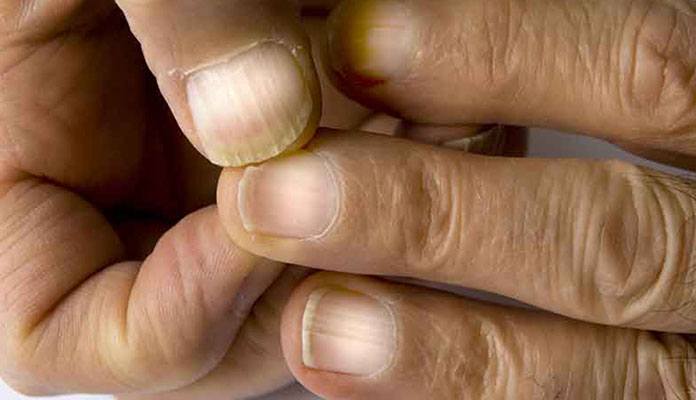

4Clinical Features of Terry’s Nails
Clinical characteristics of Terry’s nails were described by Richard Terry in 1954. This condition appears as a bilaterally symmetrical whitening in the fingernails. The whole nail bed is involved, but most of the discoloration only occurs in a narrow part of the distal border. This considerable area of opacification wipes out the lunula’s outline and forms a 0.5 to 3 mm dark or pink-brown band around the tip of the nail. The border can be uneven, even when the band is often well defined. Another clinical feature associated with Terry’s nails is the thickening of nail beds and longitudinal ridging of nail plates. [5]
Treatment Options for Terry’s Nails
In most cases, Terry’s nails do not require any medical treatments. Symptoms tend to go away once the underlying condition is successfully treated. When you require treatment, it mainly focuses on what is causing Terry’s nails. For instance, people with diabetes or liver issues may make some diet changes or take certain medications to improve these diseases. You need to consult your healthcare provider to make a proper treatment plan. [6]