
4Retrolisthesis Diagnosis & Possible Complications
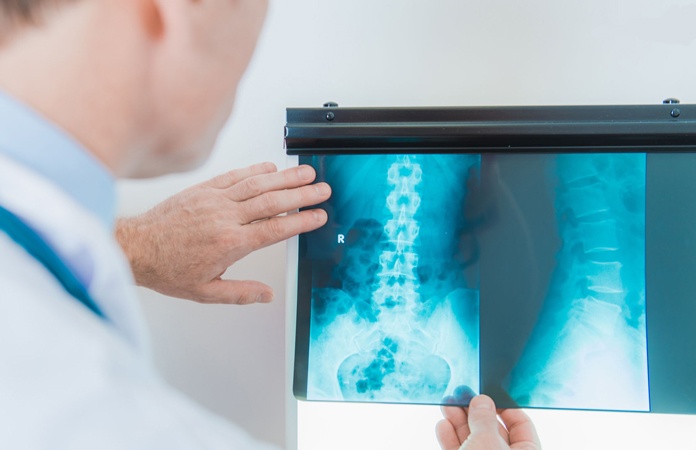
To diagnose retrolisthesis, a doctor needs to start with a review of your symptoms and overall health. Based on the results, a lateral X-ray can be done when you are standing up. The images can help determine how serious the vertebrae have been displaced out of position. Any distance over two millimeters suggests the presence of retrolisthesis. In addition, the X-ray could find out other signs that might indicate whether you have retrolisthesis. These include gas between vertebrae, bone spurs, short disc heights, or hardened arteries around your vertebrae. [5]
If retrolisthesis can be diagnosed and treated early, the slippage could be stabilized. Otherwise, the condition may become worse over time and result in complications. If left untreated, people with retrolisthesis might develop spinal cord compression or cervical spondylotic myelopathy, particularly in those people over 50 years old. If the nerves are compressed, there might be limited mobility, issues with coordination and balance, weakness and numbness in the hands and arms, or neck pain. [6]